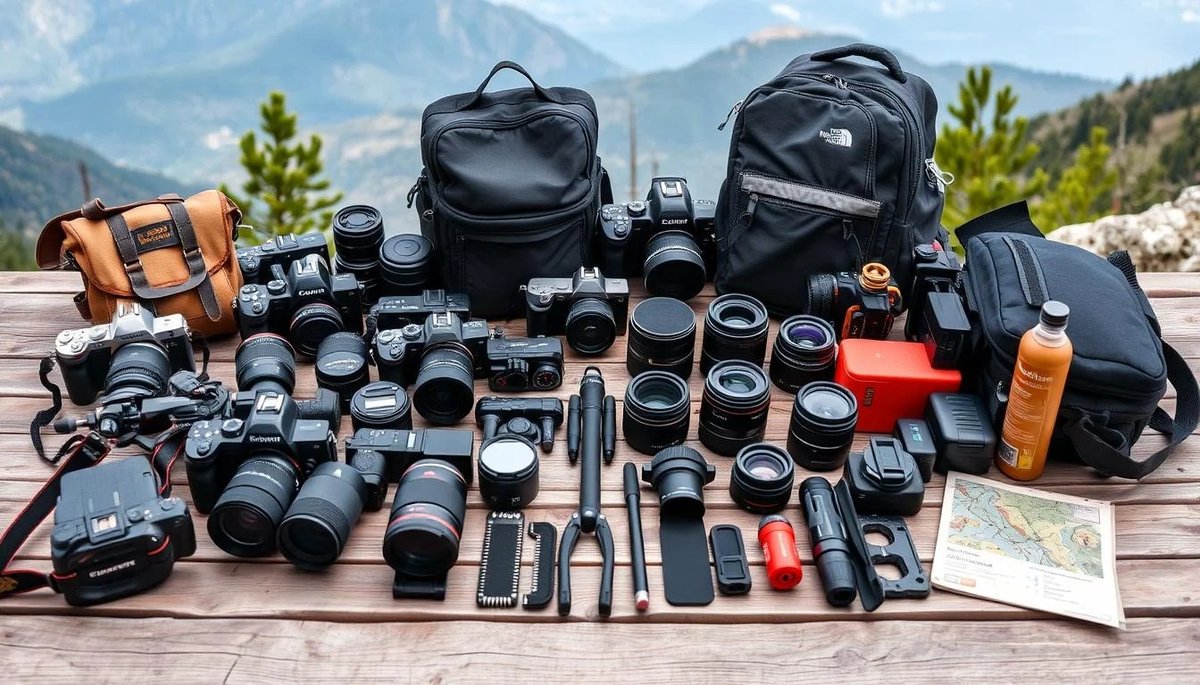
Stepping into the world of professional image-making, whether it's for breathtaking portraits, intricate product shots, or dynamic video content, demands more than just a camera. It requires a thoughtfully assembled collection of Photography & Videography Equipment, turning an ordinary space into a creative powerhouse. Building or upgrading a studio might seem daunting, but with the right gear and a clear vision, you can craft environments that elevate your craft and consistently deliver stunning results. This guide will walk you through the essentials, from the foundations of your physical space to the crucial tools that shape light, capture moments, and bring your visions to life.
At a Glance: Your Studio Equipment Essentials
- Start with Space: Optimize your studio environment for workflow and lighting.
- Master the Light: Understand continuous lights, strobes, and speedlights, then choose what fits your style.
- Shape Your Vision: Use modifiers like softboxes, reflectors, and umbrellas to sculpt light.
- Build the Scene: Essential backdrops, clamps, and props define your visual story.
- Invest in Core Gear: Select cameras and lenses tailored to your specific photography and videography needs.
- Streamline Your Workflow: Equip your digital workspace with powerful monitors, laptops, and storage.
- Support & Protect: Choose reliable stands, tripods, and cases for gear safety and stability.
- Polish & Promote: Factor in editing software, a professional portfolio, and marketing strategies.
- Level Up Your Video: Explore specialized cameras and production gear for motion capture.
Laying the Foundation: Your Studio Space
Before you even think about cameras and lights, consider the canvas itself: your studio space. A well-designed studio isn't just a room; it's a dynamic environment that streamlines your workflow and maximizes your creative potential.
Crafting Your Ideal Photo Studio Space
A functional studio space significantly boosts your efficiency and the quality of your output. It's where creativity takes shape, influencing everything from lighting setups to background choices. You have a few options for where to set up:
- Home Studios: Offer unparalleled convenience and cost savings, perfect for beginners or those specializing in smaller shoots like product photography or headshots. They require clever space optimization and diligent light control.
- Professional Studios: These dedicated spaces come equipped with advanced gear and highly controlled environments. They're ideal for photographers and videographers handling larger projects, complex lighting, or needing specific features like cyc walls.
- Rental Studios: Provide access to professional-grade equipment and varied setups without the upfront investment. They're great for one-off projects requiring specialized gear or a different look, offering flexibility and variety.
Regardless of your choice, certain features make a studio shine: high ceilings for flexible lighting, neutral-colored walls and flooring for accurate color rendition, organized storage, and ample, strategically placed power outlets to avoid messy cable runs. Don't forget natural light control – blackout curtains are a must for consistent artificial lighting.
Mastering Illumination: Essential Studio Lighting
Light is the language of photography and videography. Understanding and controlling it is paramount to creating professional, consistent, and compelling images. Your choice of lighting equipment directly impacts brightness, shadows, and color, shaping the mood and quality of every shot.
Understanding the Main Types of Studio Lights
Different projects call for different lighting approaches. Here’s a breakdown of the primary types you'll encounter:
- Continuous Lights: These provide constant illumination, allowing you to see exactly how your light and shadows fall in real-time. They typically have lower output than flashes but are beginner-friendly, excellent for video, and more budget-conscious. Modern LED panels often feature adjustable color temperatures, making them versatile for various looks. Think Godox SL60IID/SL60IIBI for an entry-level option, or the Godox SL100D/SL100BI as an editor's choice for a brighter, more versatile setup. For professional power, the Godox SL300III/SL300IIIBI offers serious illumination.
- Strobes/Flash Units: The workhorses of professional photography, strobes deliver short, powerful bursts of light. This high output is perfect for freezing fast motion, overpowering ambient light, and achieving precise control over exposure, shadows, and highlights. They're indispensable for high-fashion, commercial, and detailed product photography. The Godox AD300 Pro offers a portable yet powerful 300Ws option, while the Profoto A2 Monolight is a compact, premium choice.
- Speedlights: These are compact, portable, battery-powered flashes offering moderate power. They’re incredibly flexible for small studios, event photography, or on-location shoots where quick setup and portability are key. Speedlights like the Godox V1 Pro (with its round head and robust battery) or the compact Godox V100 are available for most major camera systems, providing reliable lighting on the go.
Shaping the Vision: Light Modifiers and Accessories
Having powerful lights is only half the battle; knowing how to shape that light is what truly separates amateurs from pros. Light modifiers are indispensable tools for creative control, allowing you to sculpt, soften, or direct light to achieve your desired effect.
Essential Light Modifiers
From gentle diffusion to dramatic highlights, modifiers are your creative toolkit.
- Softboxes: These enclosures diffuse flash or strobe light, creating a soft, even illumination that wraps around your subject. They're ideal for portraits and product shots where harsh shadows are a no-go, offering more directional control than umbrellas. You'll find rectangular, square, octagonal (Octaboxes), and strip softboxes, each with a unique effect. The NEEWER 35.4'' Octagonal Softbox is an affordable entry point, while the SmallRig 35" Octagonal Softbox offers a professional build.
- Reflectors and Diffusers: These simple yet powerful tools bounce or soften light. Reflectors fill in shadows with reflected light (often silver, gold, white, or black), while diffusers reduce the harshness of direct light sources. They're portable, budget-friendly, and perfect for achieving soft, balanced light. Consider the Godox 40"x60" Collapsible Photography Light Reflector for versatility or the K&F Concept U-Shape Reflector 180x60cm for full-body portraits.
- Studio Umbrellas: Offering a quick and easy way to soften and spread light from flashes or strobes, umbrellas are incredibly versatile. They set up faster and are more portable than softboxes but provide less directional control. Types include shoot-through (translucent fabric), reflective (silver, gold, or white interior), and collapsible designs. The Godox UB-85D Parabolic Umbrella 33.5" offers excellent light spread, while the Neewer 37" Collapsible Softbox Umbrella provides an affordable alternative.
- Other Modifiers: While softboxes, reflectors, and umbrellas are staples, don't overlook grids (for focused light), snoots (for spotlight effects), beauty dishes (for crisp, yet soft, beauty lighting), and gels (for color effects).
- Adjustable Lighting Kits: For beginners or those seeking an all-in-one solution, complete lighting kits are a fantastic starting point. They typically include lights, stands, and basic modifiers, giving you full control over light intensity, direction, and quality from the get-go. LED, flash/strobe, or hybrid kits are available. The NEEWER 2 Pack Bi Color 660 LED Video Light offers a budget-friendly 40W option, while the Godox LP600Bi Led Video Light steps up to 60W for more advanced users.
Building the Scene: Backdrops, Clamps, and Props
Once your lighting is sorted, it's time to create the visual environment for your subjects. Backdrops, clamps, and props are essential for setting the mood, theme, and storytelling of your images.
Crafting the Perfect Background
Photography Backdrops are more than just pretty scenery; they replace distractions, add personality, and focus attention on your subject. They’re crucial for achieving consistent results and a controlled aesthetic.
- Materials & Types: You'll find backdrops in various materials like seamless paper (classic, wide range of colors), muslin (fabric, soft texture, easily portable), vinyl (durable, easy to clean, good for product photography), and painted canvases (unique textures and artistic feel).
- Specific Recommendations: For newborn photography, soft, textured fabrics are key (e.g., Laeacco 3x5ft Newborn Baby Portrait Theme). Family portraits often benefit from classic, neutral tones like the Kate 10x10ft/3x3m Light Yellow Backdrop. For commercial video or special effects, a FUDESY 78.7 x 93in Extra Wide Large Collapsible Green Screen is indispensable.
Practical Studio Helpers
- Photography Clamps: These unsung heroes securely hold everything from lights and reflectors to backdrops, ensuring a stable and organized studio. C-Clamps are heavy-duty for permanent fixtures, while Spring Clamps are lightweight and versatile for quick adjustments. Multi-Purpose Grip Clamps offer extra flexibility. Grab a few Backdrop Spring Clamps With Hook – 2 Pack of 4" and Backdrop Plastic Spring Clamps – 2 Pack of 8.5" to start.
- Photography Props: Props add context, mood, and visual interest, enhancing composition and storytelling. They can range from simple fabrics and small objects (e.g., an 8PCS Geometric Cube Photo Props Set for tabletop product photography) to furniture and seasonal items. For newborn photography, a Newborn Posing Wrap can create beautiful, cozy images.
The Heart of the Studio: Cameras and Lenses
This is where your vision is translated into pixels. Your camera and lens choices are pivotal, dictating image quality, artistic flexibility, and overall performance.
Professional Studio Cameras
For studio work, you need cameras that offer high resolution, accurate color, and consistent performance. Mirrorless and medium-format cameras are increasingly popular for their detail capture, lens versatility, and reliable autofocus. Look for high-resolution sensors, accurate color reproduction, RAW support, tethering capabilities, and wide lens compatibility.
- Beginner/Budget: The Sony a6700 (24MP APS-C) or Canon R7 (32MP APS-C) offer excellent performance in a more accessible package.
- Editor's Choice (Mid-Range Pro): The Sony a7IV (33MP full-frame) and Canon R6 Mark II (24MP full-frame) strike a fantastic balance between resolution, speed, and features.
- Professional (High-End): For uncompromising detail, the Sony a7RV (61MP full-frame) or Canon R5 Mark II (45MP full-frame) deliver exceptional image quality for the most demanding projects.
The Art of Observation: Lenses
Lenses are your creative windows, designed for sharpness, clarity, and precise depth-of-field control. Your choice depends heavily on your subject matter:
- Portraits: An 85mm Prime lens offers beautiful compression and bokeh, while a 50mm Prime is versatile for full-body and environmental portraits.
- Family/Group Shots: A 35mm or 40mm prime lens provides a wider field of view without significant distortion, or a 24-70mm Zoom offers flexibility for varying group sizes.
- Fashion/Editorial: A 135mm or 150mm Prime can isolate subjects beautifully, and a Tilt-Shift Lens offers unique perspective control.
- Product Photography: A 100mm Macro lens reveals intricate details, while a 50mm or 85mm Prime works well for general product shots.
- Video/Motion: A fast 24-70mm Zoom provides flexibility for dynamic shots, and a 35mm prime is a versatile storyteller. Cine lenses are specifically optimized for professional video, offering smooth focus and precise aperture control.
Recommended Lenses: - Beginner/Budget: Sigma 28-70mm F2.8 DG DN or Canon RF 28-70mm F2.8 is STM for versatile zooms.
- Editor's Choice: Sony FE 50mm F1.4 GM Lens or Canon RF50mm F1.4 L VCM for premium prime performance.
- Professional: Sony FE 70-200mm F2.8 GM OSS Mark II or Canon RF 70-200mm F2.8 L IS USM for top-tier telephoto zoom capabilities.
The Digital Workflow Hub: Monitors, Laptops, Storage, and Printing
Beyond capturing the image, a robust digital workflow is crucial for bringing your vision to final output. This involves everything from processing power to accurate color representation and secure data storage.
Seeing is Believing: Monitors
Your monitor is critical for accurate image evaluation and client collaboration. For serious editing, look for a 4K+ resolution, an IPS panel (for wide viewing angles and color accuracy), and 99–100% AdobeRGB coverage. The BenQ SW272Q (2K, 99% AdobeRGB, Pantone validated) is excellent for color-critical work, while the Dell UltraSharp U2725QE (4K, 99% sRGB & DCI-P3) offers high resolution and broad color support.
The Powerhouse: Laptops
A powerful laptop is the backbone of a modern studio, enabling tethered shooting, RAW file editing, and client presentations. Prioritize a robust processor (Apple M4 Pro/Max, Intel i7/i9 14th gen+, or AMD Ryzen 9), ample RAM (32GB minimum, 64GB recommended), a fast SSD (1TB minimum), and a high-resolution display with accurate color (4K or Retina with 100% sRGB/AdobeRGB). Connectivity via Thunderbolt 4/5/USB-C ports is also essential. The Apple Macbook Pro 16 inch M4 Pro and Asus ProArt P16 AMD Ryzen AI 9 HX 370 are top-tier choices.
Bringing Images to Life: Printers
For photographers who offer physical prints, a professional printer is indispensable. Look for wide color gamut support (AdobeRGB/DCI-P3), your desired print size capabilities, pigment-based inks for longevity, and versatile connectivity. The Canon imagePROGRAF Professional 13" PRO-310 Wireless (with 10-color LUCIA PRO pigment inks) and Epson EcoTank Photo ET-8550 Wireless Wide-Format (with 6-color Claria ET inks and a refill system) are popular choices for gallery-quality results.
Secure Your Work: Memory Cards and External SSD Drives
Data integrity and speed are non-negotiable.
- Memory Cards: These are vital for safely storing images and videos, supporting high-speed shooting, and ensuring an efficient workflow. Prioritize high-speed classes (e.g., V90 for RAW/4K+ video), sufficient capacity (64GB, 128GB+), durability (waterproof, shockproof), and compatibility with your camera. The PNY Micro SD Card Pro (512GB, 200MB/s Read) and PNY v90 SD Card (256GB, 300MB/s Read, 280MB/s Write) offer excellent performance.
- External SSD Drives: Essential for storing, backing up, and transferring large image and video files quickly. Portable SSDs offer speeds up to 20Gbps, while SSD Enclosures with Thunderbolt 4/5 can reach 40/80Gbps using M.2 SSDs. Traditional HDDs are slower but offer high capacity for long-term archiving. Consider the PNY RP60 Portable SSD Drive (up to 2TB, 2000MB/s Read) for speed and portability, or the Acasis TB501 80Gbps SSD Enclosure (customizable with M.2 SSDs up to 8TB) for ultimate performance.
Support & Protection: Stands, Tripods, and Cases
Your valuable equipment needs robust support and reliable protection. Investing in quality stands, tripods, and cases ensures both the longevity of your gear and the stability of your shots.
Essential Stabilizers
- Light Stands: These are crucial for positioning studio lights, modifiers, and reflectors stably. Consider height range, load capacity, and material – aluminum for portability (e.g., Aluminum Neewer Photography Light Stand, up to 22 lbs), steel for durability and heavy-duty use (e.g., Stainless Steel Photography Light Stand, up to 22 lbs, great for outdoor).
- Tripods: Stabilizing your camera is paramount for sharp images, long exposures, and consistent compositions. Lightweight tripods suffice for still photography, while heavier, robust models with fluid heads are best for video. Look for stability, load capacity, and adjustability. The NEEWER 79" Video Tripod offers heavy-duty support (up to 17.6 lbs), and the SmallRig 71" Foldable Aluminum Tripod/Monopod provides versatile support (up to 33 lbs).
Protecting Your Investment
- Camera Bags: Protect your gear and keep it organized. Prioritize size/capacity, comfort (padded straps, ergonomic design), accessibility, and protection (water-resistant, shockproof materials). Choose between backpacks (Manfrotto Manhattan Camera Backpack Mover-50, 50L, for professionals), shoulder bags (Amazon Basics Large DSLR Gadget Bag for hobbyists), or rolling cases based on your workflow and travel needs.
- Photo Studio Equipment Cases: For transporting lights, modifiers, and other bulky gear, dedicated cases are vital. Look for durable construction, reinforced corners, padded interiors, customizable compartments, and portability features like wheels or backpack styles. The Neewer Trolley Case for Photo Studio Equipment is spacious and professional, while the Neewer Photo Studio Equipment Case Rolling Bag offers a lightweight, durable option.
Beyond the Shot: Editing, Portfolio, and Business
Capturing the image is just one part of the professional journey. Post-production, showcasing your work, and attracting clients are equally vital for building a sustainable career.
The Digital Darkroom: Photo Editing Software
This is where your images are refined, corrected, and brought to their full potential. Modern software offers layers, masks, color grading, lens correction, and increasingly, AI-powered tools for background removal, detail enhancement, and upscaling.
- User-Friendly & AI-Powered: Luminar Neo offers intuitive AI-powered tools, making complex edits accessible.
- Industry Standard & Comprehensive: Adobe Creative Cloud (Photoshop/Lightroom) remains the professional benchmark, offering unparalleled depth and integration, albeit on a subscription model.
Your Digital Shop Window: Website and Portfolio
A professional online portfolio is non-negotiable for showcasing your work, attracting clients, and building your brand. It needs to feature compelling galleries, highlight your specialties, include clear contact information, boast a clean design, load quickly, be mobile-responsive, and be SEO-friendly. Platforms like Pixieset are tailored for photographers, offering client management features, while Squarespace provides an all-in-one website builder with extensive customization options.
Growing Your Brand: Marketing and Branding
Even with the best gear and portfolio, clients won't find you if you don't market yourself.
Discover if its worth it to invest heavily in top-tier gear versus building a strong marketing presence. Developing a unique brand identity (logo, color scheme, voice), leveraging social media platforms, networking, and collaborating with local businesses and creatives are crucial strategies for attracting clients and establishing a strong industry presence. Your studio isn't just a place; it's a business, and marketing ensures its longevity.
Stepping into Motion: Professional Video Production Equipment
The demand for high-quality video content is booming. While many photography tools cross over, professional video production requires some specialized gear.
Types of Video Production Cameras
The camera you choose for video depends heavily on your project's scope and desired aesthetic.
- Professional Camcorders: These all-in-one units combine a camera with a video recorder, offering convenience and robustness. Professional models boast enhanced image stabilization, superior picture quality, higher recording formats (including RAW), direct live streaming capabilities, 4K resolution, and slow-motion recording. They are compact, easy to use, and often found in documentary or event settings.
- Professional Broadcast Video Cameras: Typically used in television studios and high-end film production, these cameras feature interchangeable lenses for diverse shots and professional HD-SDI outputs for external monitors/recorders. They house superior image sensors and offer a greater aperture range, making them crucial for cinematic quality. Professional POV (point-of-view) cameras are compact alternatives for capturing footage in tight or unique spaces.
- Aerial Photography (Drones) and Immersive Video (VR/360-degree Cameras):
- Drone Cameras: These remote-controlled flying platforms integrate cameras, ranging from hobbyist models to professional cinema units. Drones capture stunning bird's-eye views of landscapes and subjects, indispensable for commercial projects, real estate, and wildlife documentaries, offering perspectives unattainable from the ground.
- Virtual Reality (VR) and 360-degree Cameras: These specialized cameras produce unique, immersive shots, allowing viewers to experience a scene from every angle. They are at the forefront of interactive content, virtual tours, and cutting-edge storytelling.
Beyond these cameras, professional video production often involves a suite of production gear including professional audio recorders and microphones, gimbals and stabilizers for smooth motion, external field monitors, elaborate lighting setups (often continuous lights are preferred for video), and sophisticated editing suites. The specific tools needed will always be dictated by the vision and demands of each unique video project.
Your Creative Journey Starts Here
Building or upgrading a studio is an exciting journey that empowers your creative vision. From the fundamental structure of your studio space to the nuanced controls of light, the precision of your camera and lenses, and the efficiency of your digital workflow, every piece of Photography & Videography Equipment plays a crucial role. This guide has laid out the essential categories, providing a roadmap for both beginners and seasoned professionals. Remember, the goal isn't just to accumulate gear, but to acquire the right tools that allow you to consistently produce the high-quality images and videos your clients expect and your artistic soul craves. Start small, expand thoughtfully, and always prioritize functionality and quality that serves your specific creative goals.